
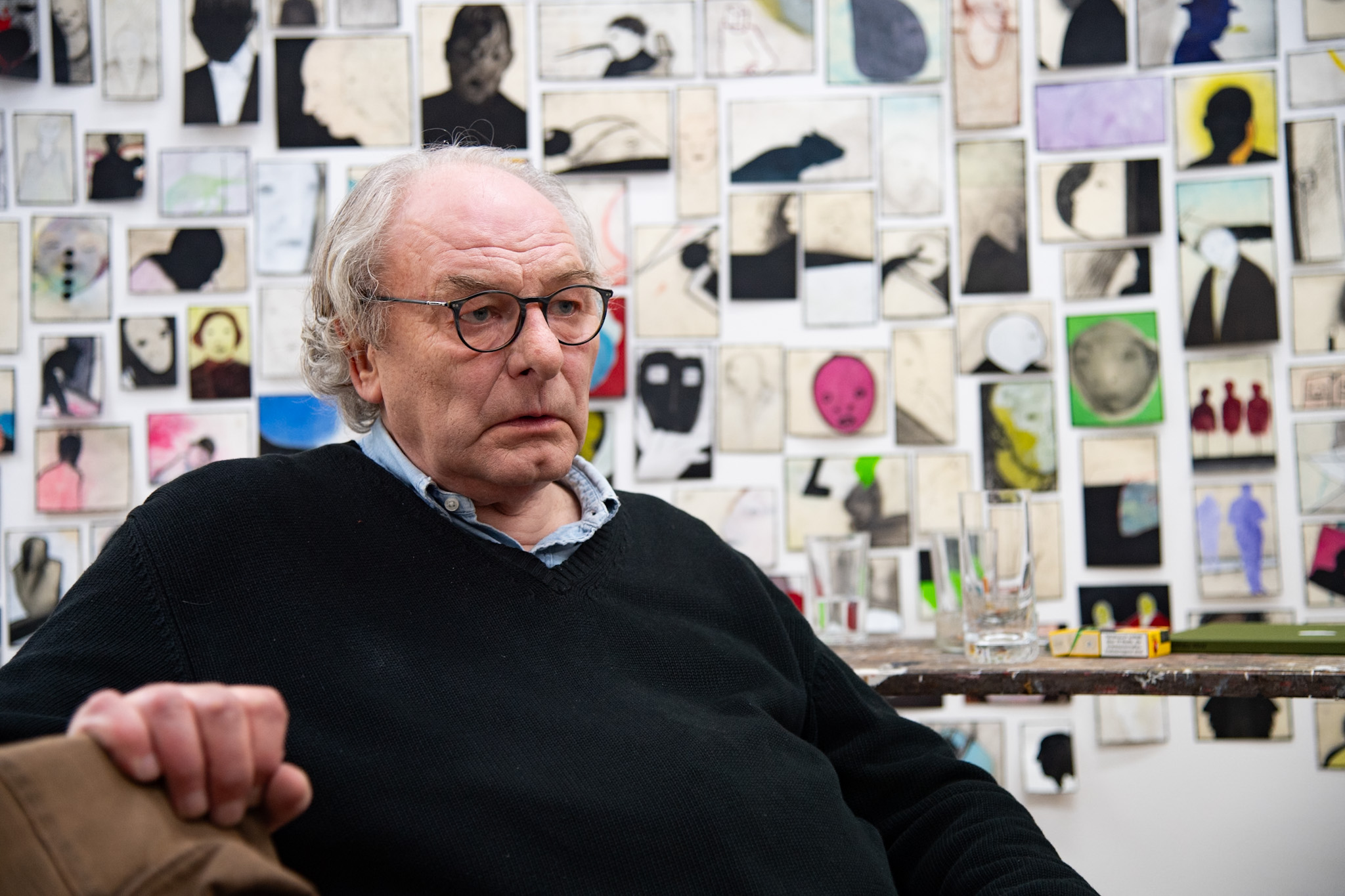
The interview was conducted on the occasion of the artist’s exhibition Max Neumann, which was open from February 3 to March 17, 2026, at the MSUCG Gallery. The conversation was led by the exhibition’s curator Natalija Đuranović, focusing on key aspects of Neumann’s artistic process, his relationship to the human figure, and the autonomy of the artwork.
N.Đ: The human figure, as the central motif of your work, reduced to a sign and an almost abstract symbol, seems to be a constant presence in your art. How do you define the significance of the human being in your work? Paul Celan once said, in relation to poetry: “Go with art into your narrowest distress. And set yourself free.” You emphasize that your paintings are created autonomously, as a result of intensive work and a carefully considered formal process, rather than as a direct expression of personal biography or momentary emotions. How do you view the relationship between personal experience and the autonomy of the artwork?
M.N: Current emotions play no role at all, but personal experiences certainly do. Experience and memory accumulate in sedimentary layers of remembrance. During the working process, they are stirred up and become part of it.
N.Đ: Your portraits are a visual representation of a universal symbol of the human being. Do you use them to question contemporary society and the position of the individual, particularly the relationship between human beings and structures of power and control?
M.N: By a portrait I mean the depiction of a specific person. You will not find that in my work, and I do not use symbols.
N.Đ: Do you believe that every medium an artist uses carries its own meaning, message, and aesthetics, inevitably determined by the context of the time in which it is created, and that this position in your work is reflected through non-narrative, static images that can be grasped at a single glance, whose graphic energy and dynamism encourage free visual interpretations without the need for storytelling?
M.N: If I wanted to comment on the state of the times, I would write. Images have the ability to communicate in a different way by provoking associations, thoughts, and feelings. I believe that every medium an artist uses has equal value, and I know no one who could escape the context of their own time. I can only confirm that.
N.Đ: In the process of painting, you experience the canvas as an “opponent.” What does the white surface of the canvas represent for you—do you perceive it as a challenge, a provocation?
M.N: It is rather a kind of playing field, on which form gradually emerges from the undefined.
N.Đ: A painting as a finished product possesses its own autonomy, inner harmony, and order of things. When do you consider your painting to be truly finished?
M.N: When it no longer asks me questions.